
LPWA Integration Framework
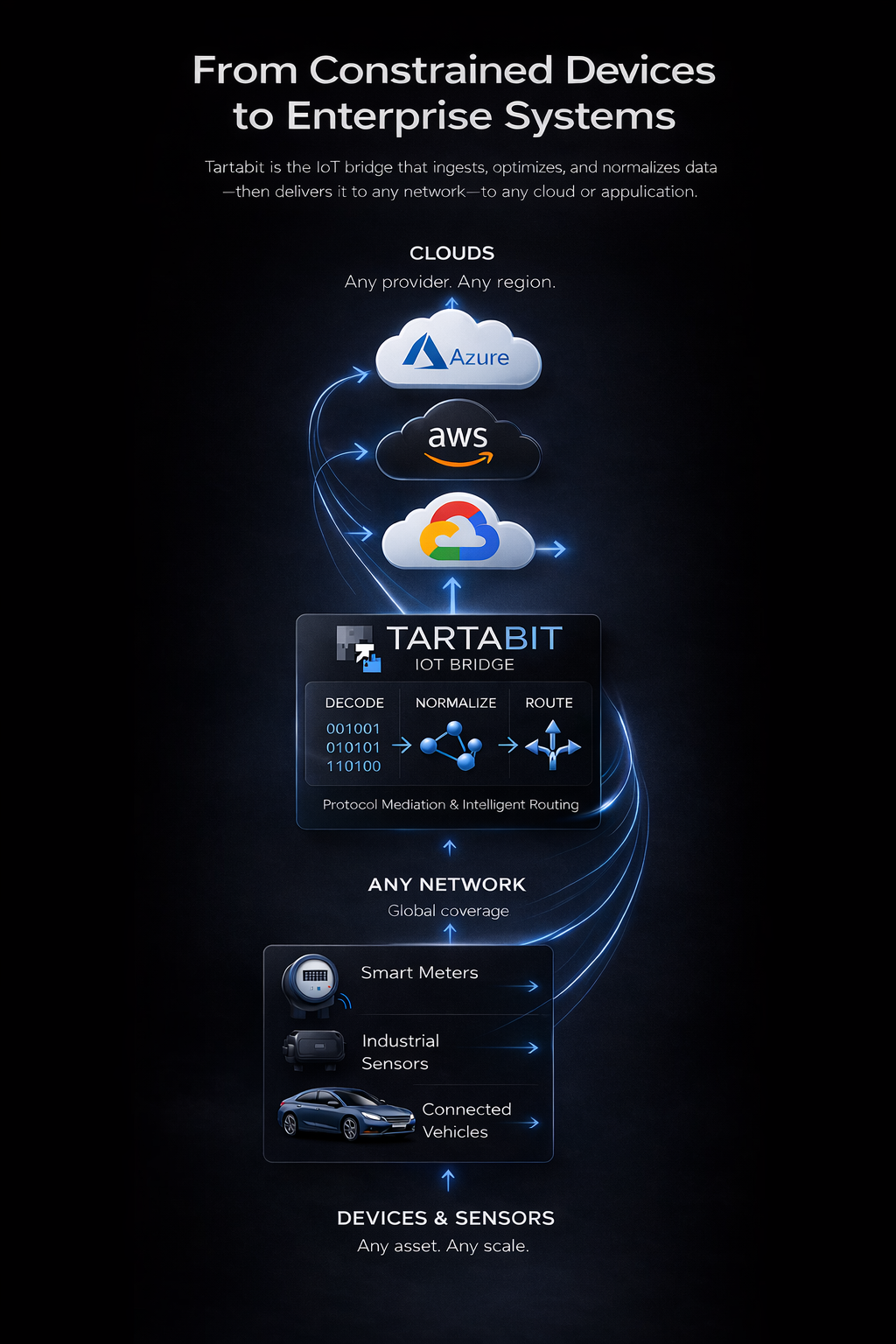
The IoT service layer between constrained devices and enterprise systems.
Tartabit IoT Bridge ingests any protocol, decodes and normalizes device data, and routes it to AWS, Azure, Google Cloud, and enterprise apps. Build once at the edge. Deliver everywhere.
- • Agentless, low/no-code transformation pipeline
- • Built for LPWAN and ultra-constrained devices
- • Deploy as SaaS, private cloud, or on-prem
Proof points
Premium infrastructure for low-power IoT at scale.
1M+
devices connected
100+
customers
14+
countries served
10K/s
packet evaluation
100+
solution templates
30+
cloud connectors






















How IoT Bridge works
Ingest
Connect any network and protocol including LwM2M, CoAP, MQTT, TCP/UDP, LoRa, or bespoke payloads.
Decode + Normalize
Use low/no-code decoders, transforms, and enrichment to standardize events across fleets.
Inspect + Filter
Apply deep packet inspection (DPI) techniques to filter, block, and route traffic from devices in the field.
Deliver
Route data to AWS, Azure, GCP, and enterprise systems with prebuilt connectors and webhooks.
Why Tartabit
A service layer designed for data-in-transit.
The service layer, not just connectivity or device management
IoT Bridge focuses on data-in-transit, translating constrained device traffic into enterprise-grade systems without rewriting the edge.
Standards and bespoke protocols, side-by-side
Support LwM2M, CoAP, MQTT, TCP/UDP, LoRa, and custom binary/ASCII with flexible decoding.
Low-code integration at hyperscale throughput
Drag-and-drop templates reduce integration time while maintaining enterprise-grade routing and governance.
Built-in fleet operations
Reporting, alerting, location, logging, and firmware CDN eliminate expensive custom tooling.
Built for your segment
Outcomes tailored to enterprise teams, utilities, network operators, device makers, and channel partners.
Enterprise fleets
Integrate devices faster, reduce DevOps burden, and gain operational visibility.
Learn more →
Connectivity providers
Launch value-added IoT services and onboard customers into their preferred clouds.
Learn more →
Device makers
Ship once, support many customer backends, and extend battery life.
Learn more →
Resellers and integrators
Create higher-value managed IoT services with a repeatable bridge into Azure, AWS, GCP, databases, and enterprise apps.
Learn more →
Utilities
Unify meters, LPWA field devices, SCADA-adjacent telemetry, and municipal sensors across vendors and protocols.
Learn more →
Why a dedicated IoT service layer wins
Device management only
Provisioning is useful, but it does not solve how operational device data reaches enterprise systems.
- XGets devices enrolled, but payloads still arrive in formats your apps cannot use directly.
- XLeaves transformation, routing, and cloud integration work for internal teams to build.
- XOutcome: managed devices, but no repeatable data pipeline.
Connectivity only
Moving packets is not the same as delivering usable IoT data to the business.
- XProvides transport, but raw traffic still needs decoding, normalization, and context.
- XOffers little help connecting device events to AWS, Azure, GCP, databases, or workflows.
- XOutcome: connectivity exists, but business outcomes remain blocked.
DIY integration glue
Custom glue looks flexible at first, then turns into a costly system your team has to own forever.
- XEvery new device, protocol, and customer integration creates more custom code to maintain.
- XSecurity, scaling, monitoring, and connector upkeep all become internal engineering burdens.
- XOutcome: delivery slows, costs rise, and architecture gets harder to trust.

IoT Bridge turns fragmented device traffic into an enterprise-ready service layer from day one.
More than device management
Automate device operations inside a tightly integrated service layer.
- +Pair device onboarding and fleet controls with the live data pipeline instead of managing them as separate tools.
- +Automate downstream actions from real device events, decoded payloads, and policy logic in one place.
- +Deploy a low-cost operational model with no per-device MRC burden layered onto the management workflow.
More than connectivity
Connect the carrier view to the application view for true end-to-end visibility.
- +Integrate with connectivity providers to enrich events with SIM, network, and service-state context.
- +Correlate transport health, device behavior, and cloud delivery in one operational picture.
- +Give teams more complete visibility across device, network, and application layers without stitching reports together.
More than DIY glue
Use a product with support, roadmap, and SLA instead of owning the entire integration stack yourself.
- +Replace one-off plumbing with a repeatable product built for ingestion, transformation, routing, and fleet-scale operations.
- +Gain vendor support and a defined SLA rather than carrying all reliability and maintenance risk internally.
- +Let engineering stay focused on customer-facing application value instead of rebuilding middleware.
Expert validation
Industry analysts agree on the service-layer gap.
“Tartabit IoT Bridge fills a major gap by combining hyperscale cloud integration with LwM2M efficiency for constrained devices, reducing development friction and letting teams focus on application value.”
James Brehm
Founder, James Brehm & Associates
Make low-power IoT data enterprise-ready.
Deploy in weeks, not quarters. Keep devices lean and integrations scalable.